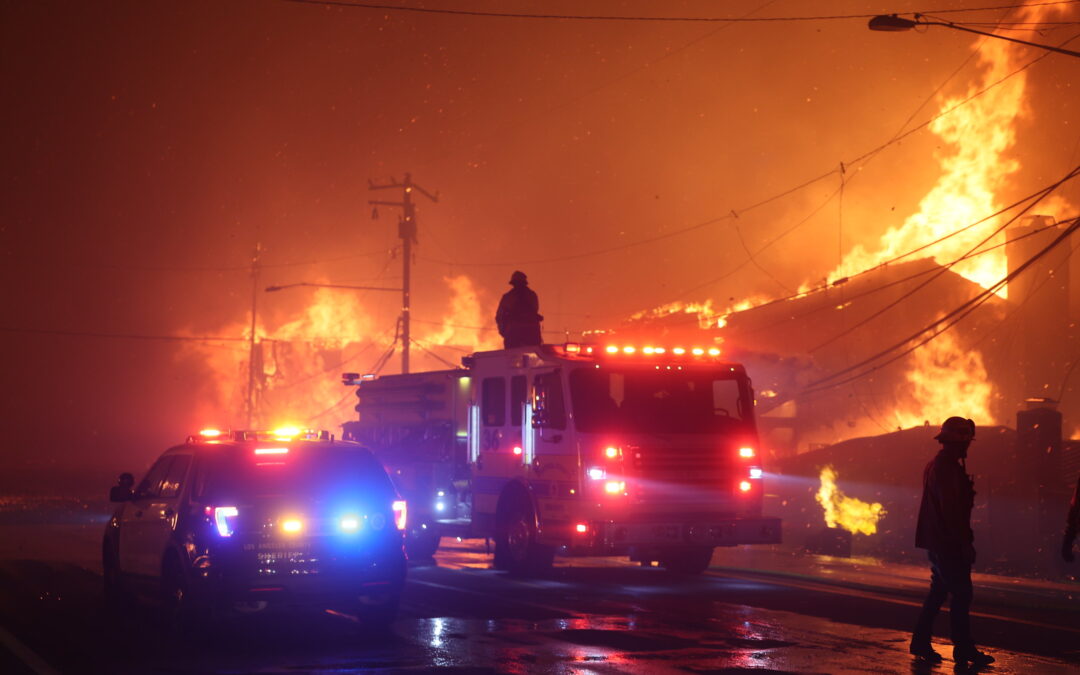
Palisades Fire, January 2025, from California Department of Forestry and Fire Protection CC BY-NC 2.0
By Rev. Richenda Fairhurst
The January Fires
“Our communities can be resilient through the love that we show for one other.”
—William Morris, Green Team leader and volunteer
during the January fires in Los Angeles.
The word “resilience” pops up much more frequently in creation care circles than it used to. There’s a growing understanding that given our current direction, the next storm, the next fire, and the next heat wave may well be more intense than the last—and we have to be ready. As such, there is a growing push to develop places of readiness and refuge, specifically, “resilience hubs.”
William Morris works with Green Faith, is a member of the California-Pacific Conference, and founded the green team at his local United Methodist church. He is still processing the shock of the January fires that roared across Los Angeles, burning 23,000 acres, from January 7th until full containment on February 14th.
Morris relates his experience, “The Palisades fire started and I could see the smoke from my house. It was morning, people were at work. It happened so suddenly, but you could tell the fire was huge. There were other fires popping up, and in places that were hard to put out. Another fire started in one of the oil fields not far from where I live.”
The firestorm rampaged through neighborhoods of homes and businesses, as well as into the hills and through wilderness. The ravages came from the Palisades, Eaton, Hurst, Lidia, Kenneth, Sunset, and Auto fires. Estimates were that 16,000 homes and buildings were damaged or destroyed. World Weather Attribution determined that climate change made the fire 35% more likely and 6% more intense.
Evacuations meant 180,000 people came under orders to leave their homes and businesses. Fleeing the fire was scary enough, but it was harder to flee from the smoke. Says Morris, “The smoke made the air actually hazardous, the worst air quality it could possibly be. It felt apocalyptic, between the smoke and the number of fires, nobody felt safe.”

Eaton/Altadena Fire, January, 2025, from California Department of Forestry and Fire Protection
CC BY-NC 2.0
Morris, like so many others in the midst of the emergency, got involved in the effort to help bring relief. His church and others became staging grounds for donations that came pouring in.
Says Morris, “I helped out where I could, especially with donations. Different churches were collecting donations that were then taken to bigger donation centers. I was transporting what was needed as well as getting information out in order to pass on the most up-to-date information possible.”
The can-do action of the churches lifted his spirits and helped with the work. Says Morris, “Through the smoke and in the aftermath, it was nice to see Cal-Pac churches opening their doors. Some became collection centers, and the many congregants who wanted to help came to keep things moving and organized.”
In reflecting on the reality of the last number of weeks, Morris notes how even though in LA people knew fires were a risk and were prepared, such devastation, especially in the middle of winter, was yet another “wake-up call.”
Yet, says Morris, despite the tragedy, the human response was affirming. “In the emergency there was an immense response. The enormity and sheer number of people who wanted to help made me feel hopeful. I have a fear people will be selfish and not share when this kind of thing strikes, and that was 100% not the case. When people saw the need that was out there, they were volunteering and giving as much as they could. People were there for one another. That gives me a lot of hope. Hope not just for the next fire, but about what we will have to face moving ahead. It gives me hope that our communities can be resilient through the love that we show for one other.”
“Our world is climate changed,” says Morris. “Resilience won’t happen on its own. Preemptive training needs to be developed around these disasters: what to pack in a go-bag, how to be trained for response in an emergency. We have to have churches think about what would have been helpful for folks to know ahead of time. We need to know how we help one another and learn from each other.”
North Carolina Floods
Kim Richmond is the Creation Care Ministry Chairperson for the Western North Carolina Conference (WNCC). The WNCC effort for creation care is among the most mature currently in an annual conference. Their experience has led them to understand just how missionally important it is to be present as people of faith to the growing need for resilience amidst the worsening impacts of climate change.
Richmond and her team learned that lesson with hands-on work. Says Richmond, “Hurricane Helene…was not the first time that North Carolina was impacted unexpectedly from an extreme weather event. In 2021 extensive flooding from Tropical Storm Fred caused loss of life—both human and our fellow creatures—and destruction of property and ecosystems throughout the area.”

Asheville, North Carolina: Maryland Army National Guard assesses the damage to Lake Lure for Hurricane Helene relief efforts in Asheville, North Carolina. The team of eight soldiers delivered pallets of baby supplies and insulin to multiple affected locations across Western North Carolina. U.S Air National Guard photo by Staff Sgt Alexandra Huettner. CC BY 2.0
Richmond shares that part of the “lessons learned” from Fred and other storms included the formation of what are in many places being called “resilience hubs.” Resilience hubs are churches or community centers that have built-in preparations for extreme events, such as solar and battery systems, as well as stored food and emergency supplies. These hubs are modeled after hubs popping up across the country, hubs that provide community support, perhaps offer classes in sustainability, but importantly, they are prepared ahead of time so that in an emergency they are ready to support first responders, save lives, and keep the power on.
Following Tropical Storm Fred, says Richmond, “Clergy members jumped in to set up hubs throughout the non-impacted areas to receive and distribute resources to hubs set up by clergy in the
impacted areas. Additional training was provided for Early Responders with many taking the training so that response efforts could grow. And efforts in the conference will continue to grow to be better able to help communities adapt and mitigate the anticipated impacts of climate change.”
Richmond recognizes that climate change is what is called a “threat multiplier.” That means that while storms have always been a fact of life on Earth, climate change is making them worse. The science backs this up. The damage from Helene in North Carolina alone was estimated at almost 60 billion dollars, impacting 4.6 million people. Millions lost access to water, food, and electricity, and 100 people died. Climate change brings higher winds and more moisture, which turns into worsened flooding.
Says Richmond, “Now is the time to assess our situation, identify our vulnerabilities, brainstorm ways to adapt and mitigate these vulnerabilities, and then engage in the action necessary to make our churches, homes, and communities more resilient to our new world where we can’t always look to the past to see what we can expect in our future.”
Richmond’s advice to others is “let’s not wait in our local churches…until we are the survivors of such an event.”
Beyond Rescue and Relief
Creating resilience hubs at this moment is good sense in any community. In the faith community, the invitation is to understand this work even more deeply. Caring for the Earth and each other is a courageous testimony to our faith.
To close, I offer a prayer for the work of resilience. I end with this quote from Rev. John Pitney, retired clergy from the Oregon-Idaho conference, and a member of the United Methodist Creation Justice Movement. He writes, “Beyond Rescue and Relief is Resilience and Resurrection. A Repaired Earth is always possible, but among us, no matter where we live, we have what we need to thrive, not just band-aided, but healed and Re-launched. Creating hubs of Resilience is the work of Resurrection.” Amen.
Rev. Richenda Fairhurst is an ordained elder in the Pacific Northwest Conference, a member of the Communications Working Group of the United Methodist Creation Justice Movement, and host of the Movement Café.